
Ancient Britain covers the history of the British Isles before the Roman invasion, spanning the Stone, Bronze, and Iron Ages. Early humans lived here nearly 800,000 years ago. Discover how tribes built incredible monuments like Stonehenge before written history began!
Did you know that the land we call Britain has a secret history stretching back almost a million years?
Before there were castles, kings, or even the famous Romans, Britain was home to incredible people who built massive stone monuments! This part of history, called Ancient Britain, covers huge time periods like the Stone Age, the Bronze Age, the Iron Age, and the time of the Roman Empire. The people who lived here before the Romans didn't even have a written language, so we are like history detectives, learning about them from the amazing things they left behind, like Stonehenge! The story of this landmass, which was once connected to Europe, is full of mystery and massive building projects.

Mira says:
"Wow! Stonehenge is so old, it was being built *before* the Great Pyramids in Egypt! Imagine spending a thousand years building one giant stone circle—that's dedication!"
What Was Life Like Before the Romans?
Long before the famous Roman armies marched in, Britain was inhabited by many different groups of people. The earliest humans we know about lived here around 800,000 years ago when Britain was still connected to mainland Europe by a land bridge!
Later, during the Iron Age (starting around 800 BC), the land was mainly home to the Celtic Britons. They weren't just one big group; they were lots of different tribes, each with their own leaders and customs, often living in fortified villages called hillforts to stay safe from each other.
These tribes were talented! They were experts at working with metal, creating amazing jewelry from gold and strong weapons from bronze and then iron. They loved storytelling and had a special religion led by wise priests called Druids.
Mind-Blowing Fact!
The mysterious monument Stonehenge took over 1,000 years to build in stages!
The Mystery of Stonehenge: An Ancient Calendar?
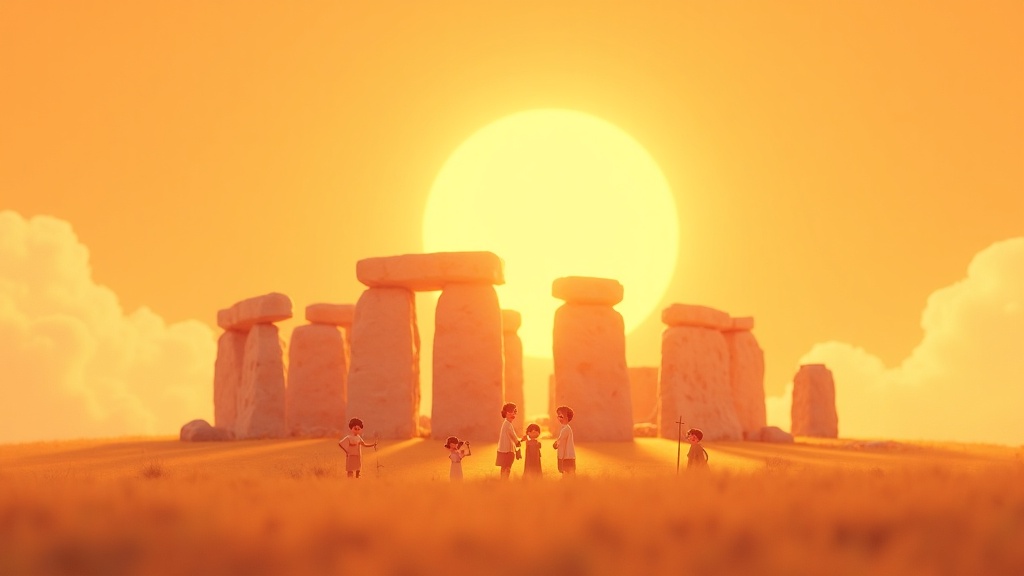
You’ve probably seen pictures of Stonehenge, those huge standing stones in Wiltshire, England. It’s one of the most famous prehistoric sites ever! It's a true wonder built by people in the Neolithic and Bronze Ages.
The stones themselves are massive. The largest ones, called Sarsen stones, weigh up to 50 tons each—that’s heavier than a large dinosaur! How people moved these giant rocks from as far away as Wales is still a huge mystery today!
Many experts believe Stonehenge was used like a giant, stone calendar to track the sun. On the summer solstice (the longest day of the year), the sun rises perfectly over a stone called the Heel Stone, shining right into the center of the circle.
When Celtic culture spread
The end of true pre-Roman Britain
Heaviest stones at Stonehenge
From AD 43 to AD 410
How Did the Romans Take Over Britain?
Around AD 43, the powerful Roman Empire decided they wanted to conquer Britain, which they called Britannia. The Emperor Claudius sent a huge army led by the general Aulus Plautius to take control of the island.
The Britons fought hard, but the Romans were an organized fighting force with excellent roads and forts. It took nearly 30 years of battling to control most of the southern part of the island.
Building the Great Wall
Even after conquering the south, the Romans had trouble with the fierce tribes in the north (in what is now Scotland). To protect their new land, Emperor Hadrian decided to build a massive border wall in AD 122!
Hadrian's Wall stretched for 73 miles across the island, standing up to 20 feet high in places, and was guarded by thousands of soldiers to keep the northern tribes out.
💡 Did You Know?
The Romans started building lighthouses in Britain, like the one at Dover, inspired by a lighthouse built by Emperor Caligula in France!
🎯 Quick Quiz!
What was the name the Romans gave to the land of Britain?
Why Did the Romans Leave Ancient Britain?
The Romans ruled Britain for almost 400 years, bringing their cities, laws, and language with them. But empires don't last forever!
As the Roman Empire got into trouble in other places, like Italy, they needed their best soldiers back home to fight off invaders like the Goths and Vandals.
Around AD 410, the last Roman soldiers packed up and left Britain, telling the local British leaders they were on their own. This moment ended Roman rule and kicked off the next exciting (and sometimes messy!) chapter of British history.
- The Stone Age: People hunted and gathered, leaving behind stone tools.
- The Bronze Age: People learned to mix copper and tin to make stronger bronze, and they started building Stonehenge!
- The Iron Age: The Celts arrived, building hillforts and mastering ironworking for better tools and weapons.
- The Roman Age: Roads, cities, and laws changed southern Britain forever until the legions marched home.
The journey through Ancient Britain shows us how much the land and its people changed over thousands of years—from people living in caves to powerful warriors, and finally to citizens of the mighty Roman Empire! It’s a super exciting story for kids to explore!
Questions Kids Ask About Ancient History
Keep Exploring Ancient Times!
From the mysterious stone builders to the arrival of the mighty Romans, Ancient Britain is packed with amazing history. Keep listening and reading to find out what happened *after* the Romans left—that’s when the Anglo-Saxons arrived!