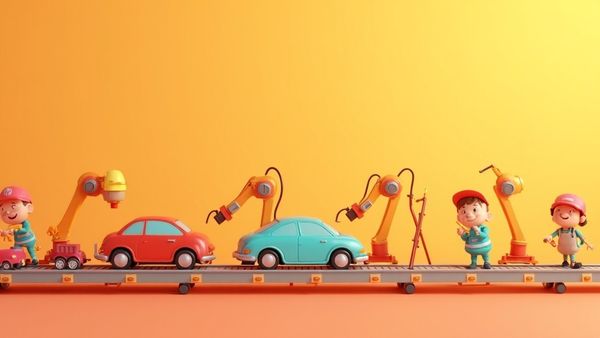
The assembly line is a manufacturing method where products move along a line, and workers perform one specific job at each station. Henry Ford reduced car-building time from over 12 hours to just 93 minutes using this method, making products faster and cheaper for everyone.
Have you ever looked at your favorite toy or a brand-new bike and wondered, 'How did they make so many of these so fast?'
If you think making something big, like a car, takes forever with just one person working alone, you're right! Before a big invention called the assembly line, making things was slow and expensive. The assembly line is a special way of making products in a factory where the item moves from one station to the next. At each stop, a worker or a machine does just one small, specific job on the product. This idea completely changed manufacturing, especially when Henry Ford used it to build his famous Model T cars in the early 1900s!

Mira says:
"It’s like building a giant LEGO set, but instead of you having to find every single piece, the pieces come to you one by one! That means more cool stuff for everyone!"
What is an Assembly Line, Anyway?
Think about building a sandwich with friends. If one person made the whole sandwich—bread, mustard, lettuce, cheese, meat, top bread—it would take a while! But if you set up an assembly line: Person 1 puts on mustard, Person 2 adds lettuce, Person 3 adds meat, and so on, you’d make sandwiches super fast!
That's exactly how a factory assembly line works for kids to understand! The product—maybe a car or a video game console—keeps moving along a track or conveyor belt. Each worker at their spot is like a station, only needing to know how to do their one part perfectly. This separation of work is called division of labor.
Mind-Blowing Fact!
Did you know that one of the earliest examples of an assembly-style system was used over 2,000 years ago to make the Terracotta Army in China? Workers made body parts like heads, arms, and legs separately, and then put them all together!
Assembly Line by the Numbers!
When Henry Ford used his moving assembly line for the Model T, the change was HUGE! Before the assembly line, building just one car took skilled workers over 12 hours of work. That’s longer than a whole school day plus homework!
With the moving assembly line, which he started using around 1913, the time it took to build one Model T dropped to only 93 minutes! That’s less time than a movie! This meant Ford could make way more cars than any other company.
(Before: 12+ hours!)
(Highland Park Plant)
(Expensive!)
(Affordable for many!)
How Did Henry Ford Make It Move?
Henry Ford didn't invent the idea of splitting up the work—people like Adam Smith talked about it way back in the 1700s! He also wasn't the very first to use an assembly line for cars (that might have been Ransom Olds in 1901).
But Ford was the master of making it move! He took inspiration from the 'disassembly lines' in Chicago meatpacking plants, where meat moved past workers who cut off one piece at a time.
The Steps of the Moving Line
Instead of the car sitting still while workers carried parts to it, Ford used conveyor belts to carry the car chassis (the bottom frame) past the workers.
Each worker stayed in one spot and did their one job—like tightening a specific bolt or attaching one wheel—as the frame rolled by them.
If a worker needed a new part, someone else brought it to them. This meant no time was wasted walking around the factory floor!
💡 Did You Know?
Because the assembly line made cars so much cheaper and faster to build, Ford started paying his workers a $5 per day wage! This was a lot of money back then, and it meant his own workers could actually afford to buy the amazing cars they were building!
🎯 Quick Quiz!
What key technology did Henry Ford use to make the assembly line *move*?
Who Benefits from the Assembly Line?
The assembly line didn't just change cars! It led to mass production, which means making tons of the same thing quickly and cheaply. This has made things like electronics, clothing, and even food much easier for everyone to get.
Today, you see the idea everywhere—from a cafeteria line serving lunch to robots putting together computer parts. It’s a brilliant way to solve the problem of 'How do we build lots of high-quality things?'
- Speed: It dramatically cut down the time it took to make a product.
- Lower Cost: Making things cheaper meant more families could buy them (like the Model T!).
- Specialization: Workers became experts at their one small task.
- Standardization: Every car came out looking exactly the same, which meant better quality control.
Even with super-smart robots doing some of the heavy lifting today, the basic concept Henry Ford perfected—breaking a big job into small, repeating steps on a moving line—is still the way many of our favorite items are built for kids and grown-ups all over the world!
Questions Kids Ask About Inventions
Keep Exploring How Things Are Made!
From ancient clay soldiers to modern smartphones, the idea of an assembly line shows us how smart people can change the world with a simple idea! What do you think they’ll invent next to make things even faster? Keep listening to History's Not Boring to find out!