
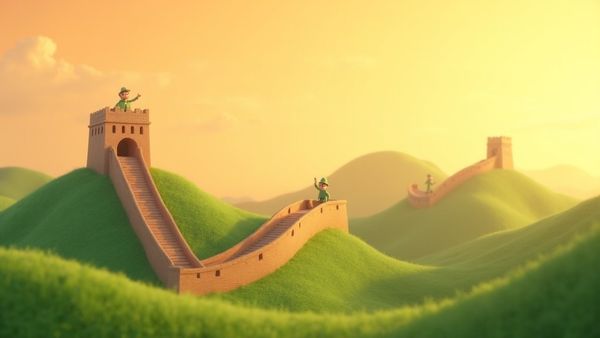
The Great Wall of China is the world's largest ancient military defense system, built across centuries to protect northern China from invaders. Its total length reaches over 13,170 miles! Learn why this massive construction project is a true world history wonder.
Hey History Explorers! Have you ever built something *really* big? Maybe a LEGO tower or a massive blanket fort? Well, get ready, because today we're talking about the biggest building project in human history: The Great Wall of China!
This incredible wall wasn't built all at once! It’s actually a massive collection of walls, forts, and trenches built over many, many years—from around the 7th century BC all the way up to the 17th century AD! The entire system stretches across northern China, connecting older fortifications to create one gigantic defense line that was meant to keep out invaders from the north. The most famous sections we see today were built by the Ming Dynasty, which ruled China between 1368 and 1644 AD.

Mira says:
"Wow, so it's like they were building a giant, continuous LEGO wall across the whole country! I wonder how many bricks that took! It must have been tough work, but super important for protecting everyone."
What is the Great Wall, really?
When we say 'Great Wall,' we don't mean one single, unbroken line of bricks, like a long garden border. Think of it more like a giant, ancient security system! It’s a network of walls, watchtowers, signal stations, and fortresses built across thousands of miles of tough land, including mountains and deserts.
The main goal was protection! China's emperors wanted to guard their lands and the important trade routes, like the Silk Road, from nomadic tribes who often rode horses and raided their farms. It was also a symbol—a way to show where the peaceful, farming lands ended and the wild lands began.
Mind-Blowing Fact!
The Chinese name for the wall, *Wànlǐ Chángchéng*, literally translates to the 'Ten Thousand Li Long Wall'! In ancient China, 'ten thousand' often just meant 'a lot' or 'immeasurable,' so the name really means the 'Immeasurably Long Wall'!
How Long and How Tall Was It?
This wall is seriously long! If you add up all the different sections built over all those centuries, the total length is mind-blowing. It stretches for over 21,196 kilometers (about 13,170 miles) in total! That’s longer than driving from New York City all the way to Los Angeles and back about six times!
The height changed depending on where it was built. On average, the Ming Dynasty walls—the ones most famous today—were built to be about 6.5 to 8 meters tall (that's between 21 and 26 feet high)! Imagine something as tall as a big, two-story house!
(Started ~680 BC)
(13,170 miles)
Over many centuries
(About 9 meters)
How Did They Actually Build It?
Building something this huge without modern machines was an incredible feat of teamwork and hard work. The materials used changed over time and depended on what was close by. Early walls used materials like rammed earth—which is dirt and gravel packed down super tight—mixed with straw and twigs.
The Ming Dynasty builders were the ones who used the sturdy materials we often see in pictures, like bricks and stone blocks. They even had a secret weapon for making their mortar (the sticky stuff that holds bricks together) super strong!
The Secret Sticky Rice Mortar!
For the Ming walls, builders mixed sticky rice soup with lime to create a strong, almost waterproof cement! This 'sticky rice mortar' helped the bricks stick together tightly, making the wall tougher against the weather and attackers.
💡 Did You Know?
It is a common story that workers who died building the wall were buried inside it, but most historians say this is a myth! However, because so many people—including soldiers, farmers, and prisoners—worked on it and suffered from exhaustion, hunger, and accidents, it earned the sad nickname, 'The Longest Cemetery on Earth.'
🎯 Quick Quiz!
What was the special, super-strong material used as mortar by the Ming Dynasty builders?
Why Did They Stop Building It?
The Great Wall was most important when China needed to defend against enemies coming from the north, especially nomadic warriors on horseback who were great at fast attacks. The wall was designed to stop horses and slow down invaders so the Chinese soldiers had time to prepare.
As time went on, China got bigger, and its borders moved further north. Eventually, the Manchu people who eventually formed the Qing Dynasty took over, making the old wall less necessary as a defense line. New kinds of fighting also made massive walls less effective than they used to be.
- Watchtowers: Placed on high points so guards could see far away.
- Signal System: Guards used smoke during the day and fire at night to send quick warnings along the wall.
- Garrisons: Small forts and barracks were built along the wall so soldiers had a place to live and store supplies.
- Border Control: The wall helped manage who came in and out, which helped control trade along the Silk Road.
Even though parts of the Great Wall have crumbled over time, or even had stones taken by locals to build homes, it remains one of the most incredible sights in the world! It's a UNESCO World Heritage Site and a symbol of China’s amazing history and perseverance.
Questions Kids Ask About World History
Keep Exploring!
Isn't that amazing? From sticky rice mortar to signals sent by fire, the Great Wall of China tells a giant story about teamwork, defense, and history! What other massive historical mysteries should we unlock next?