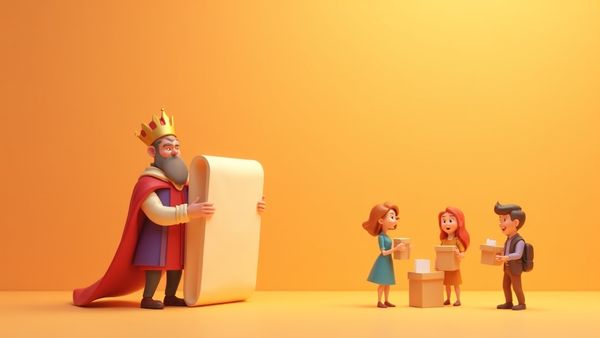
Democracy is a simple idea meaning 'rule by the people,' like when your class votes! In Britain, it started when 25 barons forced King John to sign the 1215 Magna Carta, establishing the Rule of Law where everyone follows the rules. It’s the first step to fairness!
What if *you* had to do whatever one person told you, all the time, with no questions asked? Yikes!
In a long time ago Britain, one person—the King—had almost all the power. He was the boss of everything! But slowly, over hundreds of years, people in Britain started asking for a fairer way to be ruled. This journey from a powerful king to a system where people have a say is the amazing history of democracy for kids! We'll discover how brave barons and later, regular people, pushed for rules that even the King had to follow. The first huge step was taken way back in 1215!
Mira says:
"It's so cool that even a medieval document signed by unhappy noblemen, like the Magna Carta, is the great-great-grandparent of the votes we use today! It shows that an idea for fairness can last for centuries!"
What is Democracy and Why Did Britain Need It?
Democracy is a big word that simply means 'rule by the people.' It’s like when your class votes on what game to play at recess—that’s a tiny bit of democracy! For a long time in Britain, the King ruled by 'force and will,' meaning his decision was final, no matter what.
To stop the King from being *too* bossy, people needed a way to share power. The idea was to put the Rule of Law in place. This means everyone, even the King, must follow the rules written down in law, not just their own feelings!
Mind-Blowing Fact!
The word 'Democracy' comes from ancient Greek words: *demos* (people) and *kratos* (rule), meaning 'rule by the people'!
The Big Paper That Limited the King: Magna Carta's Power
Our story for kids truly kicks off in 1215! King John was a king who loved raising money for his wars, often by making his powerful nobles, called barons, pay tons of taxes. The barons got really fed up!
They rebelled and forced King John to meet them at a field called Runnymede by the River Thames. There, he had to seal (stamp with his wax seal) a document called the Magna Carta, which means 'Great Charter' in Latin. This was a massive deal!
Magna Carta Signed
Who monitored the King
Magna Carta became English Law
How Did the King's Council Become Parliament?
The Magna Carta didn't give *everyone* a voice right away—it mainly helped the barons. But it planted a seed! It created a 'Great Council' to advise the King, which slowly turned into what we call Parliament.
The real breakthrough for representation happened later. In 1295, Parliament grew to include not just nobles and bishops, but also two representatives from each county and town in England and Wales!
Splitting into Two Houses
As time went on, this group got too big to meet all together easily. So, over the next 100 years, Parliament split into two main groups: the House of Lords (for the nobles and bishops, who kept their seats because of their title) and the House of Commons (for the knights and representatives elected by townspeople).
💡 Did You Know?
For a brief time between 1649 and 1660, England actually got rid of the King and the House of Lords entirely and became a republic called the Commonwealth! But the monarchy came back after that.
🎯 Quick Quiz!
What was the main goal of the powerful barons when they forced King John to sign the Magna Carta in 1215?
Why Do We Still Talk About Old British Rules Today?
The journey wasn't over! The 17th century saw huge arguments between Parliament and the King, like during the Glorious Revolution of 1688. This time, Parliament really cemented its power, making the monarch a constitutional monarch—meaning the King or Queen reigns, but Parliament rules and makes the laws.
These early British ideas about 'no one is above the law' and having an elected group make laws traveled all over the world and influenced democracies everywhere, including the United States!
- Rule of Law: The idea that nobody, not even the ruler, is above the law.
- Parliament's Consent: No new taxes can be collected without Parliament agreeing.
- Right to Justice: Free men gained the right to a fair trial (though 'free men' was a small group back then!).
- Representation: The start of elected people speaking for towns and counties.
Even though it took until the 1800s and 1900s for most adults (including women!) to get the right to vote, the foundation for a fair, democratic Britain was set centuries earlier by those determined barons in 1215!
Questions Kids Ask About British History
Keep Exploring How Power Changes!
Isn't it incredible how much things can change? From a powerful King to a place where your vote counts! Democracy is a story that is still being written, and it all started with brave people demanding fairness. Keep listening to 'History's Not Boring' to find out what happens next in the amazing story of Britain!