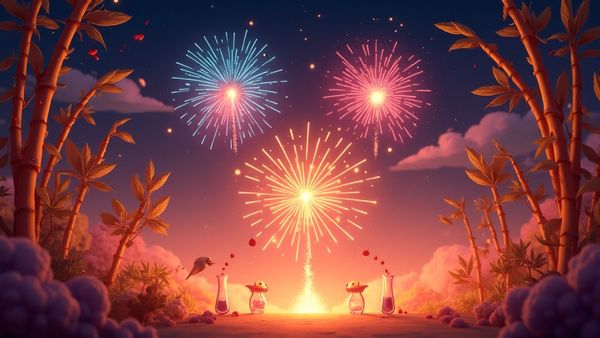
Fireworks started with natural 'firecrackers' when ancient Chinese people tossed bamboo stalks into fires, causing them to explode. True fireworks using gunpowder were invented between 600 and 900 A.D. by alchemists trying to find a secret potion for long life!
What’s your favorite part of a big celebration—the music, the food, or those incredible, colorful explosions lighting up the night sky?
Those dazzling, noisy shows are called fireworks, and they have a super exciting history! Long before dazzling displays lit up the Fourth of July, the secret to fireworks was hiding in ancient China. People there accidentally discovered the recipe for gunpowder, which led to the very first firecrackers around 2,000 years ago! The story of fireworks is a journey of science, celebration, and how a simple little pop turned into a giant, beautiful BOOM across the whole world for kids and adults to enjoy.

Mira says:
"I can’t believe they started by just throwing bamboo into a fire! The air inside must have made the *loudest* pops when it got hot. It’s like nature invented the first firecracker!"
What Were the First 'Fireworks'?
Imagine you are in ancient China, way back when the first fireworks were just a curious idea. The very first 'firecrackers' weren't man-made at all—they were natural! People noticed that when they tossed bamboo stalks into a hot fire, the air trapped inside would heat up, expand, and make a loud BANG! This noisy pop was thought to be great for scaring away grumpy or evil spirits during festivals.
The Chinese people were clever. They used this idea for celebrations, but they wanted something even better. They experimented for hundreds of years until they figured out how to make a real, powerful explosion. This next step meant discovering the secret ingredient: gunpowder!
Mind-Blowing Fact!
The Mandarin Chinese word for firecracker is Baozhu, which literally means 'exploding bamboo'!
The Magical Recipe: How Gunpowder Changed Everything
True fireworks, the kind that use a special powder, started taking shape between 600 and 900 A.D. in China. Chinese chemists, who were also called alchemists, were actually trying to find a secret potion to live forever! Instead of making themselves immortal, they accidentally mixed three main things: sulfur, charcoal, and potassium nitrate (also called saltpeter).
When they packed this mixture into hollow bamboo or paper tubes and lit a fuse, POOF! They had created the first man-made firework—a noisy firecracker! These early fireworks were simple, but they quickly became a huge part of celebrations like weddings and the New Year.
How Did Fireworks Travel the World?
Fire is fascinating, but science is even better! The knowledge of fireworks slowly traveled along ancient trade routes, like the Silk Road. Most historians believe that the famous Italian explorer, Marco Polo, helped bring the secret of fireworks back to Europe around 1200 A.D.
Once they reached Europe, people were amazed! They started making their own, and the Italians were the first Europeans to really get into manufacturing them.
From Noise to Color: The Big European Upgrade
For a long time, European fireworks were mostly just loud bangs and sparks of orange or white. It wasn't until the 1600s that firework makers, especially in Italy, started getting really creative with the colors.
They discovered that adding different types of metal salts to the gunpowder mix made the fire glow in amazing new colors! This is how they got those beautiful reds, greens, and blues you see today. By the 1830s, these new chemical tricks created the modern, brilliant fireworks we know and love!
💡 Did You Know?
Queen Elizabeth I of England loved fireworks so much that she created a special job title just for the person who made the best shows: 'Fire Master of England!'
🎯 Quick Quiz!
What was the very first 'firework' that ancient Chinese people used to make a loud noise?
Fireworks in America: Celebrating Freedom
When settlers came to North America, they brought their love for fireworks with them. On July 4th, 1777, during the Revolutionary War, people in Philadelphia celebrated the first Independence Day with fireworks!
Founding Father John Adams even said he hoped future birthdays of the country would be marked with 'bonfires' and 'illuminations.' That means lots of bright, spectacular light shows for kids and families to enjoy for years to come!
- Copper helps make flames glow blue or green-blue.
- Strontium is the chemical that makes the fireworks shine red.
- Sodium is what creates that bright, happy yellow light.
- Barium is used to make the sparkling green color.
Today, experts called pyrotechnicians use science, math, and art to design safe and stunning shows that match music and tell amazing stories in the sky. From a simple pop to a grand finale, fireworks are a beautiful reminder of how much humans love to celebrate!
Questions Kids Ask About Inventions
Keep Exploring the Sparks of History!
Isn't it amazing that something used to scare away bad spirits ended up bringing so much joy? Every time you see a colorful burst, remember those ancient Chinese alchemists who accidentally invented a world of wonder for us all! What other accidental inventions do you think changed history? Keep listening to History's Not Boring to find out!