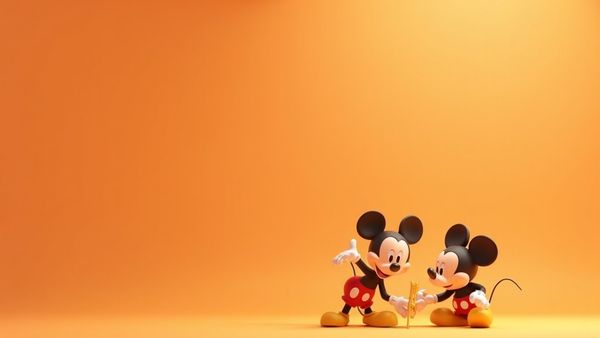
Mickey Mouse was created by Walt Disney and Ub Iwerks in 1928 after Walt lost the rights to his previous character, Oswald the Lucky Rabbit. After a disastrous contract negotiation, Walt drew the new mouse on a train ride back to Hollywood. This story shows kids how to bounce back after a big disappointment!
Hey History Explorers! Have you ever wondered how the most famous mouse in the world—Mickey Mouse—came to be? He’s been in cartoons for almost a hundred years, but his start was a true rollercoaster of good luck and bad luck!
Before Mickey Mouse zoomed onto the screen, Walt Disney had another popular character called Oswald the Lucky Rabbit. Walt and his talented animator, Ub Iwerks, made Oswald cartoons for a big company called Universal Pictures. But in 1928, Walt discovered a huge problem: Universal actually owned Oswald, not him! Walt lost the rights to his creation and even lost most of his cartoon team. It was a disaster, but Walt Disney was never one to give up! He hopped on a long train ride back to Hollywood, and guess what happened on that trip? He drew up a brand new star for kids everywhere!
Finn says:
"Wow, Finn! Imagine losing your best work and having to start completely over. That's when Walt proved he was a real history-maker. Losing Oswald was the tough challenge that forced him to invent a cartoon superstar! That’s a great lesson for all of us!"
What Was the Big Problem with Oswald the Lucky Rabbit?
The story of Mickey Mouse is really the story of bouncing back from a big disappointment. Walt Disney and Ub Iwerks had created Oswald the Lucky Rabbit, and he was a hit! Kids loved watching Oswald's funny adventures.
When Walt went to the distributor, Charles Mintz, to ask for a little more money to make even better Oswald cartoons, he was told 'No!' Worse, Mintz revealed he had secretly hired away many of Walt's artists. Because of the contract, Universal Pictures—not Walt—owned Oswald. This meant Walt was left with almost no team and no main character!
This tough moment happened in early 1928. Walt knew he needed a character he and his studio would own completely so this couldn't happen again. That's when he started sketching on that long train ride home, turning an idea for a mouse into a plan for the future!
Mind-Blowing Fact!
The first name Walt Disney thought of for his new mouse character wasn't Mickey at all—it was Mortimer Mouse! Luckily, Walt's wife, Lillian, thought that sounded a little too stuffy and suggested the catchier name, Mickey!
Mickey's First Three Attempts to Get Famous
Creating a new star isn't always easy, even for a genius like Walt! Mickey Mouse wasn't an instant success. In fact, his first two cartoons were silent, meaning there was no talking or music—just like older movies!
Walt and Iwerks first made two silent shorts: *Plane Crazy* and *The Gallopin' Gaucho*. They were shown to some people, but no one wanted to buy them. People thought the little mouse looked too much like Oswald, and they weren't excited enough to make him a star.
Walt knew what was missing: sound! In the late 1920s, movies with real sound were starting to blow people away. So, Walt and Iwerks went back to work on a third Mickey cartoon, this time adding music, sound effects, and even synchronized voices!
Release of *Steamboat Willie*
Before the hit with sound
He voiced Mickey until this year
How Did Steamboat Willie Make Mickey a Superstar?
The third cartoon, Steamboat Willie, was the big game-changer. It premiered at the Colony Theatre in New York on November 18, 1928.
Audiences were amazed! When Mickey whistled on the steamboat or clapped along with the music, the sounds matched what was happening on the screen perfectly. It was one of the very first cartoons to use sound that way—it was like magic for moviegoers!
It was an immediate sensation. People lined up to see Mickey's funny antics again and again. Suddenly, the little mouse that almost wasn't created was the biggest star in the world, and the Disney studio was saved from disaster!
Mickey's Iconic Look Developed Over Time
The Mickey you see today isn't exactly the same one from *Steamboat Willie*! In that first sound cartoon, he was often just black and white shapes. Over time, animators added details to make him more expressive and friendlier for kids.
The most famous additions were his big, bright yellow shoes and his four-fingered white gloves! Animators added the gloves so his hands wouldn't blend in with his black body on the black-and-white screen. The shoes just made him look funnier and more cartoony!
💡 Did You Know?
Did you know that Walt Disney himself provided Mickey Mouse's voice from the very beginning until 1947? Imagine being the creator and the main voice actor all in one!
🎯 Quick Quiz!
What character did Walt Disney lose the rights to, which inspired him to create Mickey Mouse?
Who Were Mickey's First Friends?
Mickey Mouse quickly gathered an amazing group of pals who have had their own fun adventures for kids across the world.
Minnie Mouse was there almost from the start, often as Mickey's sweetheart. Then came the famous trio of friends: the slightly grumpy but lovable Donald Duck, the silly and clumsy Goofy, and Mickey's loyal pet dog, Pluto.
- First Appearance (Silent): *Plane Crazy* (May 15, 1928—test screening)
- Public Debut (Sound): *Steamboat Willie* (November 18, 1928)
- First Words: “Hot dogs!” in *The Karnival Kid* (1929)
- First Color Cartoon: *The Band Concert* (1935)
From a character born out of a tough business lesson to the world's most recognizable icon, Mickey Mouse shows us that even when you lose something important, you can create something even better! Remember that quote Walt often shared: “I only hope that we never lose sight of one thing—that it was all started by a mouse.”
Questions Kids Ask About Famous People
Keep Exploring History!
Isn't it cool how a big problem led to one of the happiest characters ever? Mickey Mouse proves that with a little creativity and a great team, you can turn any setback into a huge success story for kids everywhere. Tune in next time for another amazing tale from History's Not Boring!