The Space Race was a fierce competition between the USA and the USSR to achieve major space exploration milestones first, starting around 1957 with the launch of Sputnik 1. This high-stakes contest proved which country had the best science and technology! Kids will learn about rockets and Moon landings.
Imagine two giant teams, the USA and the Soviet Union (USSR), having the biggest, loudest, and most exciting competition in human history... but instead of a soccer field, their game was in outer space! Welcome to the Space Race!
The Space Race wasn't just about who could build the coolest rocket; it was a massive, fast-paced competition that started after World War II. Both sides wanted to show the world they had the best science and technology. This huge contest kicked off around 1957 when the Soviet Union shocked everyone by launching the first artificial satellite, Sputnik 1, into orbit. The race was ON!

Mira says:
"It’s amazing how a little metal ball like Sputnik made two huge countries try so hard to fly past the clouds! It proves that even small ideas can lead to giant leaps, like going to the Moon!"
What Was the Space Race All About?
The Space Race was a big rivalry between the United States (USA) and the Soviet Union (USSR) to see who could explore outer space first and achieve amazing spaceflight milestones. Think of it like a super high-stakes contest where winning meant proving your country was the smartest and strongest in the world!
It wasn't just a friendly challenge. Because space technology could also be used for powerful military rockets, being first in space was a huge deal during a time called the Cold War. Both sides wanted bragging rights and to show off their powerful engineering for kids and grown-ups alike!
Mind-Blowing Fact!
The name 'Sputnik' is Russian for 'traveler' or 'companion'! The Soviets launched Sputnik 1 on October 4, 1957, and it was the first man-made object to orbit the Earth.
The Race Heats Up: Early Leads and Big Goals
The Soviet Union took a big early lead! Not only did they launch the first satellite, but they also sent the first living creature, a dog named Laika, into orbit on Sputnik 2 in November 1957.
The USA quickly responded by launching its own satellite, Explorer I, a few months later in 1958. That same year, the US created a brand-new agency just for space: NASA (National Aeronautics and Space Administration)!
Yuri Gagarin (USSR)
One full trip around Earth
Alan Shepard (USA)
Apollo 11 (USA)
How Did America Catch Up and Aim for the Moon?
After the Soviets sent cosmonaut Yuri Gagarin into orbit on April 12, 1961, the US felt they needed an even bigger goal to catch up! Just a few weeks later, President John F. Kennedy stood up and made a huge promise to Congress.
He announced the goal to 'land a man on the Moon and return him safely to the Earth' before the decade was over! This started the massive Apollo Program.
The Mighty Saturn V Rocket
To get to the Moon, NASA needed the biggest, strongest rocket ever built: the Saturn V! This rocket was the workhorse that made the Moon landing possible for kids to read about today.
It was a giant with three main stages that fired one after the other, dropping off weight as they ran out of fuel to keep getting faster and higher.
💡 Did You Know?
The Saturn V rocket that took humans to the Moon was about 363 feet (111 meters) tall—that’s taller than the Statue of Liberty from the ground to the tip of the torch!
🎯 Quick Quiz!
What was the name of the Soviet cosmonaut who became the very first human to orbit Earth in 1961?
The Giant Leap: Apollo 11 Lands!
Finally, on July 16, 1969, the Apollo 11 mission launched! Inside were three brave astronauts: Neil Armstrong, Buzz Aldrin, and Michael Collins. After a three-day journey, they reached the Moon!
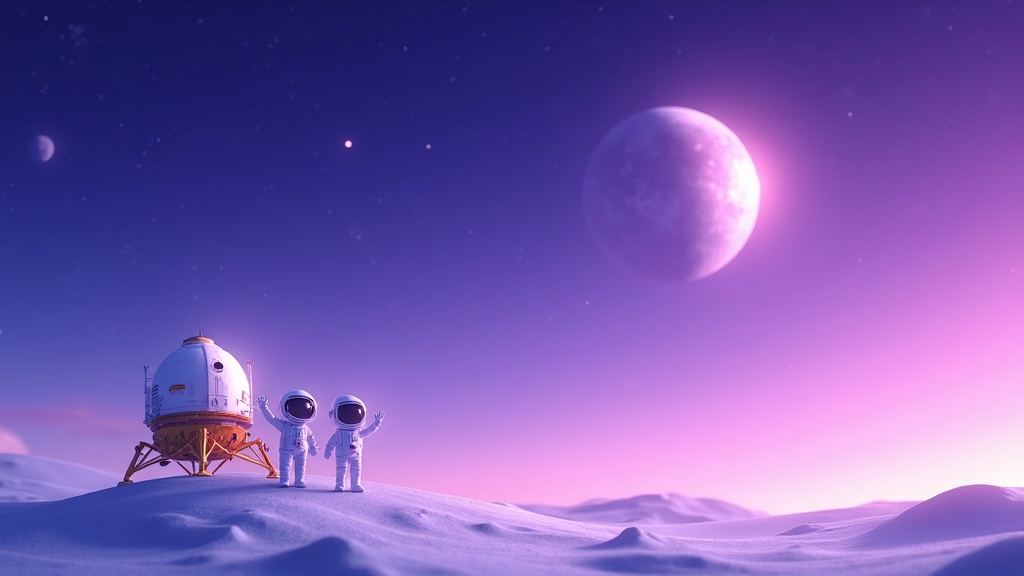
On July 20, 1969, Neil Armstrong and Buzz Aldrin climbed into the Lunar Module, nicknamed the 'Eagle,' and landed on the dusty surface in an area called the 'Sea of Tranquility.'
- Neil Armstrong stepped out first, famously saying: 'That's one small step for [a] man, one giant leap for mankind.'
- He and Buzz Aldrin spent about two and a half hours outside, collecting rock samples and planting the US flag.
- Michael Collins stayed behind, orbiting the Moon alone in the command module named 'Columbia.'
- They collected about 21.5 kilograms (47.5 pounds) of moon rocks to bring back to Earth for study!
The Moon landing was watched by an estimated 530 million people on television all over the world! Many people agree that this American victory effectively 'won' the Space Race, even though the competition slowly turned into cooperation later on with projects like the Apollo-Soyuz Test Project in 1975.
Questions Kids Ask About Space
Keep Exploring the Cosmos!
The Space Race reminds us what humans can achieve when we work hard and dream big! From beeping satellites to footprints on another world, it was an incredible time that changed history forever. What amazing thing will *you* help discover next?