
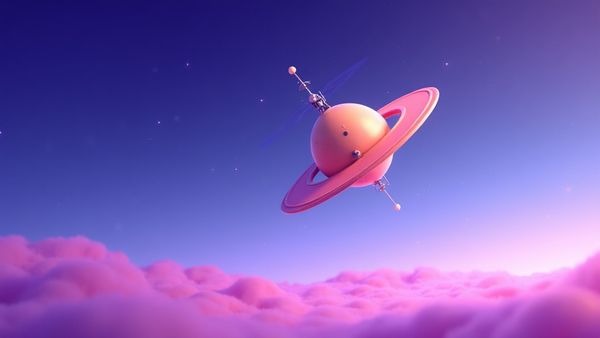
Sputnik 1 was the first artificial Earth satellite, launched by the Soviet Union on October 4, 1957. This polished metal sphere weighed 83.6 kilograms and constantly broadcast a 'beep, beep' signal. This single launch kicked off the massive Space Race between the US and the Soviet Union.
Did you know that for a little while in 1957, the night sky had a brand new, little moon buzzing overhead?
It wasn't a real moon, though—it was the first-ever artificial Earth satellite! This incredible invention was called Sputnik 1, and it was launched by the Soviet Union on October 4, 1957. This little metal ball zooming around Earth was only about the size of a large beach ball, but it changed history in a HUGE way! It kicked off something massive called the Space Race between the Soviet Union and the United States. For kids learning about space, Sputnik is the starting line!

Mira says:
"Wow, Finn! Imagine building something so small that it could fly higher and faster than any plane, and people all over the world could *hear* it with their radios! Sputnik proved we could actually leave Earth's backyard!"
What Was Sputnik 1, Anyway?
Sputnik means the Russian word for 'satellite' or 'fellow traveler'—how cool is that? Sputnik 1 wasn't a fancy robot or a spaceship with astronauts; it was mostly a polished metal sphere. Think of it like a shiny, high-tech Christmas ornament, but it was packed with scientific tools inside its 83.6-kilogram (184-pound) body.
Its whole job was to prove the Soviet Union *could* launch something into orbit. To do this, it had four long antennas sticking out of its sides, kind of like long metal whiskers. These antennas sent out the famous, simple signal that made it famous: a steady, repeating 'beep, beep' sound that radio operators could pick up all over the world.
Mind-Blowing Fact!
The simple 'beep-beep' signal from Sputnik actually helped scientists study space! By listening to how the signal changed, they learned about the air high up in Earth's atmosphere, called the ionosphere.
Sputnik's Wild Ride: How Fast and How High?
Once Sputnik was successfully launched by its powerful R-7 rocket, it was traveling at a dizzying speed! To stay up in space and not immediately fall back down, it had to move incredibly fast.
It completed a full circle around the Earth—one orbit—in just about 96 minutes. That means it saw the sunrise and sunset about 16 times a day!
(About the size of a large beach ball)
(184 pounds)
(Completing about 14-15 orbits per day)
(How long the batteries lasted)
How Did This Little Sphere Stay Up There?
Sputnik 1 didn't fly like an airplane; it was constantly falling towards Earth, but moving sideways so fast that it kept missing the ground! This is what an orbit is.
Its path wasn't a perfect circle—it was an elliptical orbit. This meant its height changed throughout each trip around the planet.
Orbit Heights
At its closest point (called Perigee), Sputnik skimmed just 215 to 228 kilometers (about 134 miles) above the ground. Down here, it felt a tiny bit of air resistance, which is like very slight drag.
At its farthest point (called Apogee), it soared up to about 939 to 945 kilometers (around 583 miles) high. Up there, it was much clearer of the atmosphere!
💡 Did You Know?
The Soviet Union launched Sputnik 1 during the International Geophysical Year, a time when scientists all over the world agreed to study Earth and space together. But Sputnik turned a friendly science project into a huge technological competition!
🎯 Quick Quiz!
What famous sound did Sputnik 1 broadcast back to Earth?
Why Did Sputnik Matter So Much?
The launch of Sputnik 1 was a massive shock to people in the United States. Many Americans thought their country was the most advanced in the world, so hearing a 'beep' from a Soviet satellite made them worry that the U.S. was falling behind in science and technology.
This competition became known as the Space Race! The 'beep' wasn't just a science signal; it was a political message that the Cold War race for new technology was now happening in outer space.
- Sputnik's launch led the U.S. government to pour more money into science and technology programs.
- It directly caused the creation of NASA (National Aeronautics and Space Administration) in 1958 to organize America's space efforts.
- It pushed schools to focus more on teaching science and math to make sure the next generation could compete!
- It inspired the United States to set the massive goal of landing a person on the Moon before the end of the 1960s.
Sputnik 1 only worked for 22 days before its batteries ran out, and after three months in orbit, it re-entered Earth's atmosphere and burned up on January 4, 1958. But in that short time, this simple sphere showed the world that space travel was possible, officially kicking off the most exciting race in human history!
Questions Kids Ask About Space
Keep Exploring the Cosmos!
From a tiny 'beep' in the sky to the incredible rockets we have today, it all started with Sputnik 1. You are living in a world built on the foundations of that first small satellite! Keep looking up and learning about space—who knows what amazing things *you* might invent next?