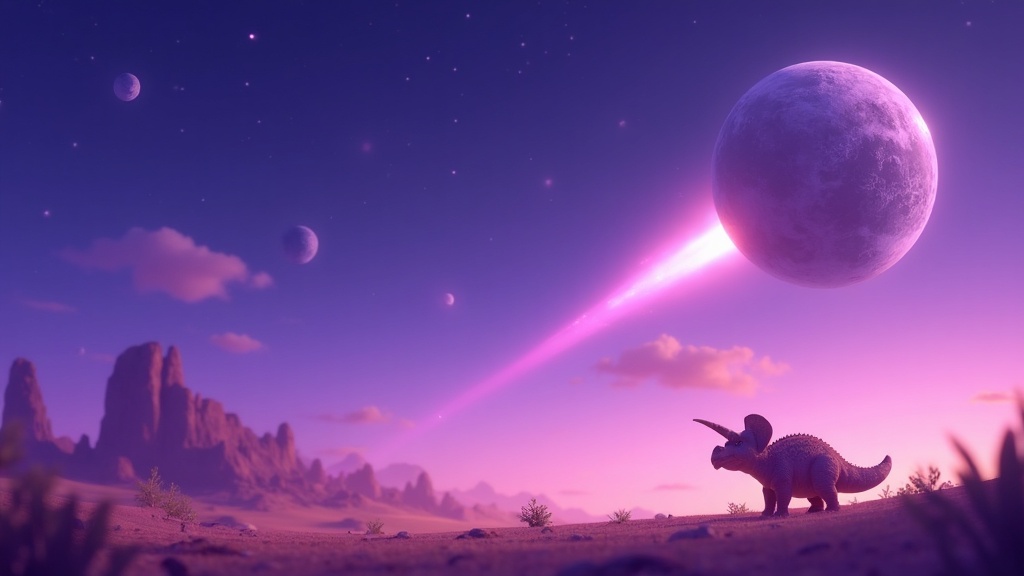
The extinction event that killed the dinosaurs, officially the K-Pg event, was caused by a massive asteroid slamming into Earth 66 million years ago. This impact was millions of times more powerful than all nuclear bombs combined, causing catastrophic global change. Discover this amazing prehistoric disaster story!
Imagine a world ruled by giants—T-Rexes roaring, long-necked Brachiosauruses munching on trees, and Pterodactyls soaring overhead! That was life for over 150 million years!
But suddenly, about 66 million years ago, these amazing creatures vanished! It’s one of history’s biggest mysteries, but scientists have a super strong idea about what killed the dinosaurs for kids to learn about. It wasn't a slow change; it was a catastrophic, world-changing event!

Mira says:
"It’s wild to think that something from outer space—way, way out there—could change life on Earth so much! It reminds us how connected our planet is to the rest of the universe."
What Caused the Great Dinosaur Disappearance?
For a long time, scientists argued about whether volcanoes, a slow climate change, or something else got rid of the dinosaurs. But now, most experts agree on one huge suspect: a giant space visitor!
This event is officially called the Cretaceous–Paleogene (K-Pg) extinction event. Say that five times fast! It was the day a huge asteroid, or maybe a comet, slammed into our planet.
Mind-Blowing Fact!
The asteroid that likely killed the dinosaurs was estimated to be about 6 to 9 miles (10 to 15 kilometers) wide! That's bigger than Mount Everest is tall!
How Big Was the Impact and What Happened Next?
Picture this: an object moving incredibly fast—faster than any jet you’ve ever seen—smashing into the shallow ocean near what is now the Yucatán Peninsula in Mexico. The impact was millions of times more powerful than all the world's nuclear bombs combined!
The immediate blast was catastrophic, vaporizing rock and sending a massive plume of dust and debris miles up into the atmosphere. This wasn't just a big rock hitting; it was a world-changing bang!
The K-Pg Event Happened
Size of the Chicxulub Crater
Loss of Marine Species
How Did the Dust Cloud Kill the Dinosaurs?
The initial explosion was terrible, but the real killer for most dinosaurs was the aftermath. The dust and soot shot into the sky spread all over the globe, creating a thick, dark blanket.
Step 1: Darkness and Cold
This cloud blocked out the sun for months, maybe even years! Think about your backyard on a dark, rainy day—now imagine it being *that* dark, but everywhere, all the time. No sunlight meant plants couldn't make food.
Step 2: Food Chain Collapse
When plants (the dinosaurs’ food source) died off because they couldn't get sun, the plant-eaters (herbivores) starved. When the plant-eaters vanished, the meat-eaters (carnivores) like T-Rex had nothing left to hunt. It was a chain reaction!
💡 Did You Know?
While most dinosaurs died out, not *everything* perished! Tiny, furry, ground-dwelling mammals—our distant relatives—managed to survive the darkness, paving the way for mammals (and eventually humans!) to take over the world!
🎯 Quick Quiz!
Which large geological feature marks the spot where the huge asteroid hit Earth?
Who Survived the Great Dying?
It sounds scary, but not every animal disappeared! The extinction event wiped out about 75% of all species on Earth, but some groups were tougher than others. This is a key lesson for kids learning about history and nature!
Scientists look for evidence of the survivors to understand how life bounced back.
- Birds: They are the direct descendants of one group of small, feathered dinosaurs, making them the true dinosaur survivors!
- Crocodiles and Alligators: They can slow down their bodies and live a long time without food, helping them ride out the dark times.
- Turtles and Snakes: Many smaller reptiles burrowed or lived in water, which buffered them from the worst of the surface temperature drops.
- Mammals: The small, adaptable ancestors of dogs, cats, elephants, and us made it through!
So, while the giant, spectacular dinosaurs are gone, their legacy lives on in every chirping bird you hear today! It’s a reminder that even the biggest endings can lead to amazing new beginnings for other life forms on our planet. Keep listening to History's Not Boring to learn more about these incredible times!
Questions Kids Ask About Prehistory
The Aftermath: A New World!
The day the asteroid hit was certainly the end of the dinosaurs' 150-million-year reign, but it was the beginning of *our* story! Without that world-changing event, mammals like us might never have had the chance to thrive. What an incredible chapter in Earth's history!