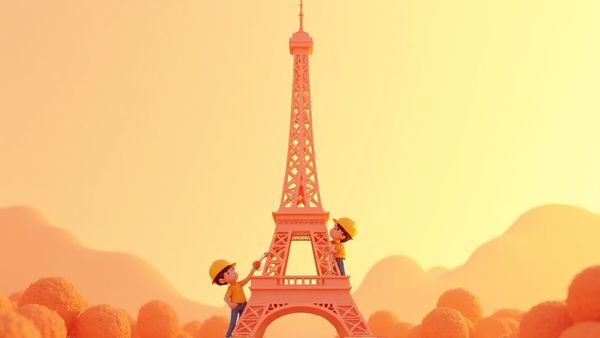
The Eiffel Tower was built for the 1889 World's Fair to celebrate 100 years since the French Revolution. It used 18,038 iron pieces and stood as the world's tallest structure! Learn the incredible story of its speedy construction in Paris, France.
Have you ever looked up at a super-tall skyscraper or a famous tower and wondered: Who on earth built that?!
Today, we’re traveling all the way to Paris, France, to uncover the story behind one of the world’s most famous structures: the Eiffel Tower! This amazing iron giant was built for the 1889 World's Fair to celebrate 100 years since the French Revolution. It was a huge engineering challenge because, at 324 meters (1,063 feet) tall, it was the tallest human-made structure in the world when it was finished! But the real question is, who designed this towering beauty and whose hands actually put it together?

Mira says:
"Wow, I thought only one person was in charge! It’s so cool that a whole team of smart engineers and hundreds of workers had to work together like a giant puzzle to build something so tall!"
What is the Eiffel Tower Made Of?
Before we meet the builders, let’s talk about what the tower is! It’s not made of stone like a castle; it’s made almost entirely of wrought iron in a beautiful, airy pattern called a lattice structure.
This lattice pattern is like a giant, super-strong metal honeycomb. The engineers chose iron because it was much lighter than stone but still incredibly strong. They wanted to prove that metal could be used to build super tall things that could handle the wind!
The whole structure is made up of about 18,038 individual pieces of iron all bolted and riveted together. Imagine having to keep track of almost twenty thousand puzzle pieces!
Mind-Blowing Fact!
The Eiffel Tower has a nickname in French: La Dame de Fer, which means 'The Iron Lady'!
The Tower By the Numbers
Building something this huge in the late 1800s was like launching a rocket today—it required incredible planning and precision. The construction lasted for just two years, two months, and five days! That’s super fast for something so massive.
To hold all that iron up, the builders had to dig deep foundations, some going down 22 meters (72 feet). They used special tools to make sure the bases for the four huge legs were perfectly level.
Started Jan 1887, Finished Mar 1889
Bolted and riveted together
The massive building cost in 1889
From 1889 until 1930
How Did They Actually Build the Iron Legs?
The construction of the tower was a big adventure! It didn't start with a giant crane; it started with super careful groundwork.
First, the team poured thick concrete slabs for the base of each of the four legs. Since two legs were near the Seine river, they needed extra-deep foundations, which they created using cool compressed-air techniques.
Lifting the Iron Pieces
The iron pieces were made in a factory and brought to the site. For the lower parts, the builders used scaffolding and clever temporary wooden supports.
Once the legs reached the first level, the team used hydraulic jacks—which are like giant, powerful jacks—to push the massive iron legs into their exact, perfect alignment so they could be connected!
💡 Did You Know?
When the tower was first finished, the lifts (elevators) to the very top weren't ready! The first visitors had to climb all 1,710 steps to see the view!
🎯 Quick Quiz!
What major event was the Eiffel Tower built to celebrate?
Who Gets the Credit for the Design?
This is the tricky part! Everyone knows the name Gustave Eiffel, and yes, his company, Compagnie des Établissements Eiffel, designed and built it. He was the boss and the one who got the final contract.
However, the very first ideas for the tower came from two engineers who worked for Eiffel: Maurice Koechlin and Émile Nouguier. They sketched the original 'great pylon' idea.
They then worked with the architect Stephen Sauvestre to make the design look more beautiful and grand for the contest.
- Gustave Eiffel: The famous engineer and company owner who championed the project and took the main credit. He also helped design the framework for the Statue of Liberty!
- Maurice Koechlin & Émile Nouguier: The brilliant engineers who came up with the original concept and drawings for the structure.
- Stephen Sauvestre: The architect who added the beautiful arches and design details that made the final plan win the contest.
It took all these talented people—designers, engineers, and hundreds of everyday construction workers—to bring this iron lady to life! Even though some artists at the time called it a 'monstrous' eyesore, the Eiffel Tower quickly became the beloved symbol of Paris and engineering genius for kids and adults around the world.
Questions Kids Ask About World History
Keep Exploring History's Greatest Structures!
From the blueprints of two engineers to the hard work of hundreds of ironworkers, the story of the Eiffel Tower shows us what happens when people dream big! Next time you see an amazing building, remember to ask: who were the masterminds behind the construction? Keep listening to 'History's Not Boring' to discover more incredible stories from around the world!